

How to Reduce Stress at Home: Habits That Last
At a Glance
- Most stress routines fail because they're too big and too disconnected from daily life — the fastest path to lower stress isn't a 60-minute program, it's stacking 2–5 minute interventions into moments that already exist in your day
- Microinterventions accumulate into real physiological change: a 5-minute cold rinse, a 2-minute breathing reset, a brief walk after dinner
- Environment is your first and most underused intervention — your space is actively shaping your nervous system before you do anything else
- Consistency over intensity: one focused minute of breathwork done daily for six months outperforms a 30-minute session done sporadically
- Heat therapy may support cortisol regulation and sleep quality in some people — best layered in once your baseline habits are consistent
Chronic stress doesn't announce itself with a dramatic event. It creeps in through a pile of unanswered emails, a restless night, a jaw that won't unclench by 9 p.m. Over time, those small moments compound into a pattern that quietly erodes your energy, sleep quality, and focus.
The good news is that building lasting stress reduction habits doesn't require a therapist's office or a gym membership. It requires the right environment, a clear understanding of your stress pattern, and the patience to let consistency do its work.
Know Your Stress Pattern Before You Build a Routine
Here is what most habit guides skip entirely: stress is not a single experience. It has three distinct patterns — and solving the wrong one is why most routines don't last.
Find Your Stress Pattern in 3 Questions
Do you feel it in your body? Muscle tension, elevated heart rate, fatigue, jaw clenching — you have a physical stress pattern. Prioritize movement, heat therapy, and cold exposure.
Do your thoughts spiral? Racing thoughts, catastrophizing, rumination that won't stop — you have a cognitive stress pattern. Prioritize journaling, structured problem-solving, and mindfulness.
Do your habits slip? Avoidance, overeating, social withdrawal, skipping things you know help — you have a behavioral stress pattern. Prioritize environmental design, habit stacking, and social accountability.
Most people have a primary pattern with secondary elements. Identify yours now — everything that follows will land differently when you're solving the right problem.
Start by tracking when and where you feel most stressed at home. Is it the moment you walk through the door after work? During the hour before bed when your mind races? A simple journal entry each evening for one week reveals your personal stress windows with surprising precision.
Environment: Your First and Most Underused Intervention
Your environment is actively shaping your nervous system before you do anything deliberate. The visual clutter on your counter, the blue light from your TV at 10 p.m., the absence of a place that signals "this is where I rest" — these are stressors running in the background all day. Fixing them costs nothing and pays off immediately.
Research suggests these space adjustments may help lower ambient stress:
- Remove visual clutter from at least one room you use daily — even one cleared surface shifts the cognitive load
- Designate a "no work" zone — a specific chair, corner, or room your brain learns to associate with rest
- Add one or two plants — snake plants and pothos are excellent, low-maintenance options
- Set a "shutdown alarm" 60 minutes before bed — this becomes the trigger for your entire wind-down stack: dim lights, screens off, heat therapy or breathwork
- Use a diffuser with lavender or eucalyptus to anchor your decompression ritual with a consistent sensory cue
The consistent evening ritual has the highest return on investment: very high impact, lowest effort, fastest results. Start there before adding anything else.
The habits you build in a well-designed environment are simply easier to sustain — friction is removed before you even start.
Tools and the Art of Habit Stacking
You don't need to invest heavily upfront. Start with what you have and layer in purpose-built tools as your routine solidifies.
Core tools for a home stress reduction practice: a yoga mat for dedicated movement space, a journal or habit tracker app for daily check-ins, a timer to structure mindfulness sessions without clock-watching, a sleep tracker to quantify rest quality, soothing audio (playlists, nature sounds, or binaural beats) for decompression windows.
Habit stacking is the most underused tool in behavior change. It means linking a new behavior to one you already do reliably — so the existing habit acts as a trigger. Evidence-based approaches to managing chronic stress consistently support starting small with SMART goals and building through stacking rather than willpower.
Instead of scheduling 20 minutes of meditation, attach a two-minute breathing exercise to your existing morning coffee ritual. It requires zero extra scheduling. Here is how common habits stack naturally:
- Box breathing (4 counts in, hold, out, hold) → stacked with morning coffee or tea
- Three-sentence evening reflection → stacked with brushing teeth
- 10-minute stretch or walk → stacked with lunch break
- Infrared sauna session → stacked with post-workout cooldown or evening wind-down
- 2-minute cold rinse → stacked with morning shower
.
Core Stress Reduction Routines to Build

These are evidence-informed building blocks of a functional stress reduction system. Match them to your stress pattern first, then layer in as capacity allows.
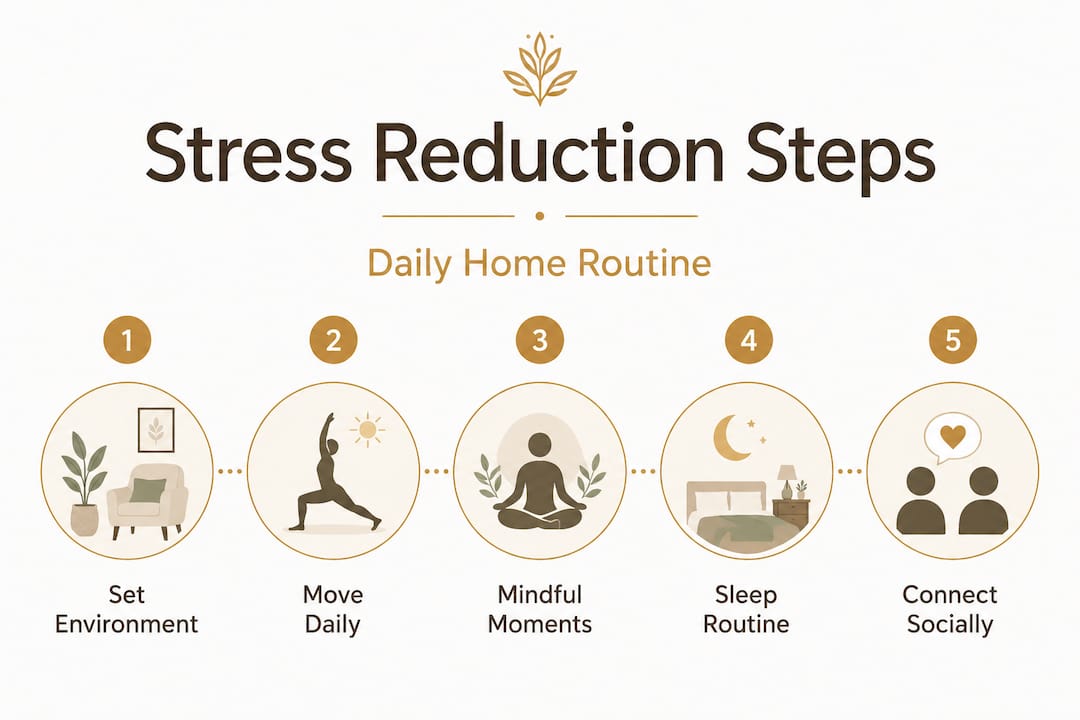
- Establish a movement baseline. Regular aerobic exercise reduces stress hormones and boosts endorphins — aim for 150 minutes of moderate or 75 minutes of vigorous activity weekly. A brisk 30-minute walk five days a week meets the threshold. Movement is the highest-return intervention for physical stress patterns.
- Start a mindfulness practice small. Mindfulness practices like focused breathing, body scans, and meditation lower cortisol and improve focus. Start with one to five minutes daily. One focused minute of box breathing done daily for six months outperforms a 30-minute session done sporadically.
- Protect your sleep window. Seven to nine hours of adequate sleep is when your body processes cortisol and consolidates emotional regulation. Set a consistent bedtime, keep your bedroom cool and dark, and avoid screens for at least 30 minutes before sleep.
- Build in cognitive check-ins. Cognitive stress — the internal narrative you run about your problems — is often the loudest driver of chronic stress. Two brief daily check-ins, mid-morning and before bed, interrupt the rumination cycle. A simple prompt like "What is one thing I handled well today?" shifts focus. Essential for cognitive stress patterns.
- Invest in social connection. Isolation amplifies stress. Even brief, meaningful interactions lower the body's stress response. Schedule one social touchpoint per day — even a five-minute phone call counts.
Your Minimum Effective Daily Baseline
If you only do this — consistently — you will reduce baseline stress over time.
- 5 min — movement (walk, stretch, bodyweight)
- 2 min — breathing reset (box breathing or slow exhale)
- 5 min — wind-down (no screens, dim lights)
- 3 min — reflection (one sentence: what went well, what felt hard)
Tracking Progress and Handling Setbacks
A meta-analysis found that mindfulness-based interventions reduce perceived stress with a standardized mean difference of -0.53 compared to controls in non-clinical adults. That number tells you the change is real and detectable — not just subjective. You can track your own version through a simple daily stress rating from one to ten, recorded each evening.
Realistic timeframe expectations:
- Increased awareness of stress triggers; some resistance to new habits
- Sleep quality may begin to improve; mood stabilizes slightly
- Noticeable reduction in baseline tension; habits feel more automatic
- Measurable improvements in focus, emotional resilience, and baseline energy
Common setbacks and how to handle them:
- Missed days: Don't treat a missed day as failure. Restart the next morning without guilt. The habit isn't broken — it's paused.
- Motivation dips: Revisit your original reason for starting. Write it down and keep it visible.
- Plateau in results: Introduce a new modality — cold exposure, a different movement style — to stimulate adaptation.
- Overwhelm: Reduce your habit stack to one non-negotiable behavior and rebuild from there.
What Works Long Term (And Why Most Routines Fail)
The majority of people who fail at building stress reduction routines aren't failing because they lack discipline. They're failing because they're solving the wrong problem — matching a physical stress solution to a cognitive pattern, or vice versa.
The second uncomfortable reality is that microinterventions often outperform marathon routines. A five-minute cold rinse, a two-minute breathing reset between meetings, a brief walk after dinner. These small, frequent inputs to your nervous system accumulate into meaningful physiological change. The brain doesn't reward grand gestures. It rewards repetition.
Most failures also come from skipping the support structure. Willpower is a limited resource. Your environment, your tools, your social accountability, and your reward loops are the infrastructure that carries you when motivation fades. That's why a multi-modal system — rather than a single habit — produces lasting results.
The reward loop is often overlooked. If your stress reduction practice feels like a chore, it won't last. Building in genuine sensory pleasure — the warmth of a sauna, the clarity after a cold plunge, the calm of a quiet morning ritual — makes the habit intrinsically rewarding. That's the difference between a routine you maintain and one you abandon.
Once your baseline habits are consistent — movement, breathwork, sleep protection, and evening wind-down — adding structured recovery tools can meaningfully accelerate results, especially for people dealing with physical stress patterns or sleep disruption. The Finnmark FD-5 Trinity XL combines infrared heat, steam, and red light in one unit, making it a natural next layer for households that have already built the foundation.
Build Your Home Recovery Stack
Once your baseline habits are in place, the right tools accelerate results — from infrared saunas to contrast therapy bundles designed for daily recovery.
FAQ: Common Questions
How long does it take to build a stress reduction habit?
Most people need at least six months of consistent practice for stress reduction habits to become automatic, though early benefits like improved mood and sleep can appear within the first few weeks. Consistency matters more than any single session.
Is it better to start with one habit or try multiple at once?
Start with one. Habit stacking links new behaviors to existing routines, making change feel manageable rather than overwhelming. Add a second habit only once the first feels automatic — usually after two to four weeks.
What if my motivation drops after a few weeks?
Revisit your original purpose, reduce friction in your environment, and return to basics. Setting a "shutdown alarm" and designating a relaxation zone can reignite the habit by making it easier to access — not by adding more willpower.
Are home-based habits as effective as group classes or clinics?
Home routines can be equally effective when practiced consistently. Research shows no clear superiority for group or clinical settings over well-structured self-directed routines.
Which stress pattern should I address first?
Start with the pattern most dominant in your daily experience. Physical stress (tension, fatigue) responds best to movement and heat therapy. Cognitive stress (spiraling thoughts) responds best to journaling and mindfulness. Behavioral stress (habit slippage) responds best to environment redesign and accountability. Solving the right pattern first dramatically increases your success rate.
Recommended
- Balance Over Burnout: A Real-Life Weekend Wellness Routine – Marterra Elements
- Home Spa Health Benefits: The Science Behind a 47% Lower Hypertension Risk – Marterra Elements
- Saunas for Stress, Sleep, and Mental Recovery – Marterra Elements
- Relaxation Therapy Methods: Reduce Stress and Boost Wellness
- How to Release Stress and Anxiety: Tips You Should Know – LongevityBotanicals
This article is for informational purposes only and does not constitute medical advice. If you are experiencing significant mental health concerns, please consult a qualified healthcare provider.