

Chromotherapy: Science, Methods, and Wellness Benefits
At a Glance
- Chromotherapy uses visible light to support mood and relaxation — effects are primarily psychological
- It is not scientifically proven to treat physical conditions and should not replace medical care
- Small studies show reduced anxiety in specific contexts, such as patients undergoing stressful medical procedures
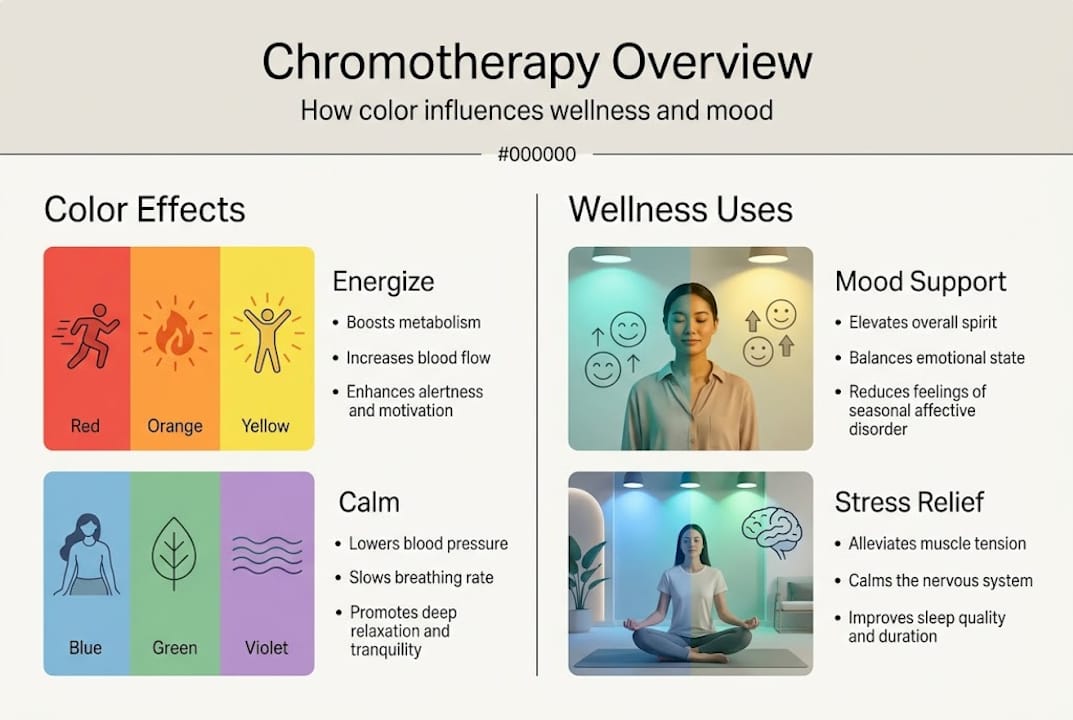
- Warm colors (red, orange, yellow) tend to stimulate; cool colors (blue, green, violet) tend to calm — effects are primarily psychological
- Many modern infrared saunas include adjustable LED color panels, making chromotherapy easy to layer into existing heat therapy routines
- Best used as one layer of a broader relaxation routine alongside evidence-based practices
Chromotherapy sits at a strange crossroads: dismissed by some as pure pseudoscience, overhyped by others as a cure-all. The truth is more nuanced and, frankly, more interesting. Color therapy is a complementary wellness practice that uses visible light to influence mood and relaxation — and while it won't replace your doctor, it may support psychological relaxation in wellness settings when used correctly.
This guide walks through what chromotherapy actually is, how it is believed to work, what the research says, and how you can try it safely as part of a broader wellness routine.
What Is Chromotherapy? Core Principles Explained
Chromotherapy, also called color therapy, is the practice of using visible light wavelengths to influence mood, relaxation, and perceived wellbeing. It draws from ancient traditions across Egyptian, Greek, Chinese, and Ayurvedic medicine. Today, practitioners use it within alternative wellness settings — from spas to meditation studios to home environments.
The core idea is that colored light influences perception and mood via visual cues. Different colors are associated with different psychological responses, and exposure to specific colors is thought to shift how we feel. These effects are primarily perceptual and psychological, not direct physiological interventions.
- What it is: A complementary wellness tool using colored light for mood support, relaxation, and psychological wellbeing
- What it isn't: A replacement for medical treatment, or scientifically proven to treat physical conditions
- How it differs from red light therapy: Red light therapy uses specific near-infrared and red wavelengths with documented physiological effects at the cellular level. Chromotherapy uses the full visible spectrum primarily for psychological influence via visual perception.
- Where it's practiced: Spas, wellness centers, infrared saunas, meditation rooms, and increasingly, home setups
"Color therapy is not about shining a flashlight on your skin and expecting a cure. It's about creating an environment where your nervous system can shift into a calmer, more receptive state."
This distinction matters because it sets realistic expectations and prevents people from abandoning a useful relaxation tool simply because it can't do what it was never designed to do.
How Chromotherapy Works: The Science and the Spectrum
Chromotherapy is understood to work primarily through visual perception and nervous system response rather than direct cellular stimulation. When you are exposed to a particular color, the theory holds that your nervous system responds — shifting your perceived emotional and physiological state accordingly.
Here is how the major colors are broadly categorized by their perceived effects:
- Warm colors (red, orange, yellow): Associated with perceived stimulation, increased alertness, and motivation
- Cool colors (blue, green, violet): Associated with calm, relaxation, and mental clarity
- Neutral colors (white, gold): Often linked to perceived balance and a sense of harmony
| Color | Wavelength Range | Perceived / Intended Effect |
|---|---|---|
| Red | 620–750 nm | Perceived stimulation, alertness |
| Orange | 590–620 nm | Perceived creativity, uplift |
| Yellow | 570–590 nm | Perceived focus, optimism |
| Green | 495–570 nm | Perceived balance, calm |
| Blue | 450–495 nm | Perceived calm, reduced arousal |
| Violet | 380–450 nm | Perceived relaxation, introspection |
It is worth clarifying how this relates to red and infrared light therapy. The two practices overlap in color but diverge sharply in mechanism and evidence base. Red light therapy works through cellular photobiomodulation — a distinct and more clinically studied process.

Methods of Chromotherapy: Practical Applications
Chromotherapy methods include visual exposure, lights directed on the body, colored room environments, and LED saunas. Each approach varies in accessibility, cost, and the depth of the experience it creates.
| Method | Ease of Use | Evidence Level | Best Setting | Est. Cost |
|---|---|---|---|---|
| Visual exposure | Very easy | Low | Home | Free |
| Direct light | Moderate | Low to moderate | Spa or home | $50–$300 |
| Colored environment | Easy | Low | Home or studio | $100–$500 |
| Meditation with color | Easy | Anecdotal | Anywhere | Free |
| LED sauna session | Moderate | Low to moderate | Home or spa | $500+ |
The growing popularity of full-body red light therapy devices has brought chromotherapy features into the mainstream. Many modern infrared saunas now include adjustable LED color panels, letting users layer chromotherapy onto their heat sessions for a more complete sensory experience.
What Does the Science Say? Evidence, Benefits, and Criticisms
The honest answer is that the evidence is preliminary, with the strongest signals for mood and anxiety improvement in small studies. Psychological effects are better supported than physiological ones, and chromotherapy should not be used as a treatment for any diagnosed physical condition.
Key findings from current research:
- Small studies show reduced anxiety in specific contexts, such as patients undergoing stressful medical procedures [1]
- Mood and perceived relaxation improve with colored light exposure in controlled settings [1][2]
- Psychological benefits align with broader research on light exposure and environmental design for wellbeing
- A systematic review of photobiomodulation confirms that red and near-infrared light has moderate evidence for pain relief — but this operates through a distinct cellular mechanism, separate from chromotherapy
Critics highlight the lack of robust biological mechanisms and the real risk of patients delaying necessary medical care in favor of color-based treatments. These are legitimate concerns, particularly when chromotherapy is marketed with exaggerated claims about treating disease.
The balanced view: chromotherapy is a low-risk, potentially mood-supportive complementary practice. It is not a cure. Used alongside evidence-based care, it can contribute meaningfully to relaxation and stress management.
The Real Value and Limits of Chromotherapy
Chromotherapy's real strength is environmental and perceptual. It creates a sensory context that supports relaxation, reduces mental noise, and may make other wellness practices more effective. For stress reduction and mood support, that is genuinely useful.
What we would caution against is using it as a standalone solution for anything clinical. Chromotherapy is safe and genuinely useful for relaxation — but it is not a substitute for medical care. The wellness space benefits from honesty here. Overpromising damages trust and, more importantly, can lead people away from treatments they actually need.
If you enjoy the atmosphere, the calm, and the ritual of a color-lit sauna or meditation session, lean into it. Just keep it in its proper place alongside evidence-based red light therapy and other well-researched tools.
The Finnmark FD-5 Trinity XL infrared sauna combines full-spectrum infrared heat with adjustable colored LED lighting — a layered sensory experience built for deep relaxation. For solo sessions, the single-person full-spectrum sauna delivers the same quality in a compact, home-friendly design.
FAQ: Chromotherapy
Is chromotherapy safe?
Chromotherapy is generally safe for psychological and relaxation purposes when used responsibly. It carries primarily perceptual effects with low risk. Avoid if you are photosensitive or on medications that increase light sensitivity — consult a doctor first. It should never replace medical treatments for diagnosed conditions.
What are the main benefits of chromotherapy?
Chromotherapy may help reduce stress, improve mood, and support relaxation. Small studies show reduced anxiety in specific clinical contexts, and mood improvements have been observed with colored light exposure. Strong evidence for treating physical disease does not currently exist.
What's the difference between chromotherapy and red light therapy?
Chromotherapy uses the broad visible spectrum primarily to influence mood and perceived wellbeing through visual cues. Red and near-infrared light therapy (photobiomodulation) operates through a distinct cellular mechanism — absorbed by mitochondria to influence ATP production and tissue repair — and has moderate evidence for pain relief. They are separate practices with different mechanisms and different evidence bases.
Can I use chromotherapy at home?
Yes. Home-based chromotherapy is accessible through colored lights, painted environments, or LED-equipped devices like infrared saunas. It is one of the easiest complementary wellness practices to integrate into a daily routine at low cost.
Who should avoid chromotherapy?
People with photosensitivity conditions or those taking medications that increase sensitivity to light should consult a healthcare provider before using chromotherapy. Anyone managing a diagnosed physical condition should continue established medical treatment and not substitute chromotherapy in its place.
Add Chromotherapy to Your Wellness Routine
Explore infrared saunas with adjustable LED color panels — layered sensory experiences built for relaxation and recovery.
Recommended
- Red Light Therapy: Benefits, Science & Home Use – Marterra Elements
- The Science of Infrared Heat: How Warmth Transforms Wellness – Marterra Elements
- Sauna, Cold Plunge, Repeat: How Contrast Therapy Affects Circulation & Recovery – Marterra Elements
- Home Spa Health Benefits: The Science Behind a 47% Lower Hypertension Risk – Marterra Elements
Sources
- Azeemi STY, Raza SM. "A Critical Analysis of Chromotherapy and Its Scientific Evolution." Evidence-Based Complementary and Alternative Medicine, 2005. ncbi.nlm.nih.gov
- Radeljak S, et al. "Chromotherapy in the Regulation of Neurohormonal Balance in Human Brain — Preliminary Study." Collegium Antropologicum, 2008. pubmed.ncbi.nlm.nih.gov
- Hamblin MR. "Mechanisms and Mitochondrial Redox Signaling in Photobiomodulation." Photochemistry and Photobiology, 2018. For context on the distinct mechanism of red/NIR light therapy. pubmed.ncbi.nlm.nih.gov
This article is for informational and educational purposes only. Chromotherapy is a complementary wellness practice and is not intended to diagnose, treat, cure, or prevent any disease or medical condition. Always consult a qualified healthcare professional before making changes to your health routine, particularly if you have a pre-existing condition, are pregnant, are photosensitive, or are taking medications that affect light sensitivity.