

Facial Red Light Therapy: Real Results for Home Skincare
At a Glance
- Red light may support collagen production and related repair processes and may support skin healing — effects develop gradually with consistent use
- Clinical studies suggest it may help reduce wrinkles, improve redness, fade dark spots, and support recovery in some users
- Common home protocols use 5 to 20 minute sessions, two to five times per week, for several weeks with devices with transparent specifications
- Research supports benefits for some skin concerns — individual outcomes vary and long-term data beyond 6 months remains limited
- Too much exposure may reduce the desired effect or irritate skin — biphasic dose response applies
- Expect gradual change over weeks, not days — consistency matters more than device price
Facial red light therapy has moved well beyond the spa. Clinical studies suggest it may help reduce fine lines, fade dark spots, smooth uneven texture, and support skin recovery — all from the comfort of your home. Yet misconceptions still linger. Many people assume at-home devices are watered-down versions of professional equipment, or that any visible improvement is placebo.
Current research supports some of these claims, but not all of them equally. If you want to know exactly how this technology works, what results you can realistically expect, and how to build a routine that delivers, this article gives you a clear, evidence-based path forward.
How Facial Red Light Therapy Works
Facial red light therapy achieves its results not through heat or chemicals, but through targeted light energy absorbed by your cells. Understanding the mechanism makes it easier to choose the right device and use it correctly.
Red and near-infrared light used in therapy typically falls within the red and near-infrared range, commonly around 630 to 850 nanometers for skin applications. Red wavelengths (600 to 700nm) work primarily at the skin's surface layers, while near-infrared light (700 to 1100nm) reaches deeper into the dermis and underlying tissue. For facial skincare, the most studied range sits between 630 and 660nm for visible red and extends into near-infrared for deeper collagen support.
The biological process starts at the mitochondria — the energy-producing centers of your cells. Light absorbed by cytochrome c oxidase triggers a cascade that increases ATP production, reduces oxidative stress and inflammation, may support collagen production and related repair processes, and improves local blood flow.
| Wavelength | Penetration Depth | Primary Benefit |
|---|---|---|
| 630–660nm (red) | Surface to mid-dermis | Collagen, texture, acne |
| 810–850nm (NIR) | Deep dermis and tissue | Inflammation, supporting skin healing |
| 940nm (NIR) | Deepest tissue layers | Circulation, wound support |
- Supports collagen production and elastin stimulation for firmer, smoother skin
- Reduces inflammatory markers that contribute to acne and redness
- Supports cellular turnover and repair processes in treated skin
- Improves blood circulation for a more even, healthy complexion over time
"The real power of red light therapy lies in its ability to support your body's own repair mechanisms, rather than introducing any foreign substance or abrasive process."
For home devices, look for units that clearly disclose wavelength in nanometers, irradiance, and intended use. A device that cannot provide these specifics is difficult to evaluate. Explore the full science of red light therapy to understand how wavelength selection affects every outcome you care about.
Clinical Benefits for Your Skin
Research suggests that consistent red light exposure may help reduce fine lines and wrinkles, lighten dark spots, smooth skin texture, diminish redness, ease acne symptoms, and support recovery after minor skin trauma in some users. Results vary by individual, device, and protocol.
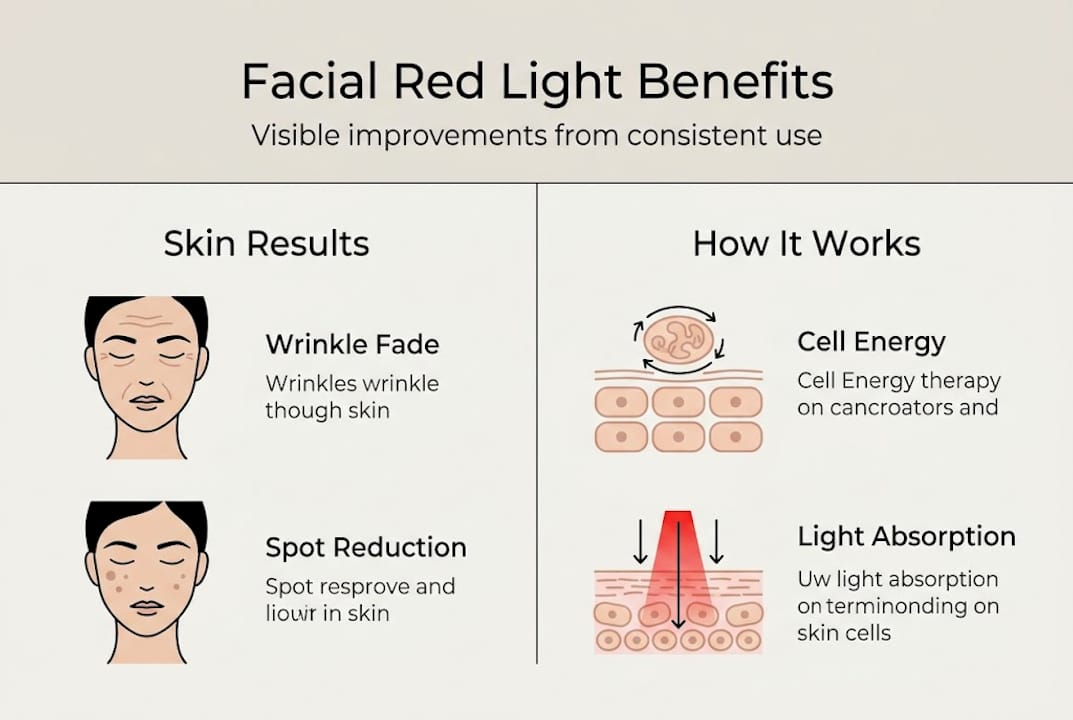
Here is how professional and home devices compare in general terms — note that actual performance varies significantly by specific device and design:
| Feature | Professional Spa Device | Home Mask or Wand |
|---|---|---|
| Irradiance | Typically higher — varies by unit | Typically lower — varies by unit |
| Session length | 10 to 20 min | 10 to 20 min |
| Frequency | Weekly clinic visits | Daily or near-daily possible |
| Cost per session | $50 to $200 | Amortized over device life |
| Consistency advantage | Lower | Higher — home use may make it easier to stay consistent |
Additional benefits supported by research in some users:
- Acne reduction: Anti-inflammatory effects may calm active breakouts and support reduced scarring
- Dark spot fading: Improved cellular turnover may lift hyperpigmentation gradually over time
- Redness relief: Reduced vascular inflammation may lead to a more even tone
- Post-procedure support: May support recovery after microneedling, peels, or laser treatments — consult your provider
For a broader perspective, the full-body red light benefits guide covers how these benefits extend across the whole body.
Protocols for At-Home Facial Red Light Therapy
Consistency is the single most important variable. Common home protocols use 5 to 20 minute sessions, two to five times per week, for several weeks. One important concept to understand is the biphasic dose response: too little light produces no meaningful effect, while too much exposure may reduce the desired effect or irritate skin.
Anti-Aging & Texture
3 to 5 sessions per week for at least 8 weeks. Results are gradual — track with weekly photos in consistent lighting to observe cumulative change objectively.
Active Acne
4 to 5 sessions per week during a breakout cycle. Anti-inflammatory effects are among the more consistently supported benefits in the literature.
Post-Procedure Support
Daily use for 1 to 2 weeks following treatment — consult your provider first. Evidence for post-procedure healing support is one of the stronger application areas.
Maintenance
2 to 3 sessions per week once target results are achieved. Consistency during maintenance may help preserve cumulative gains.
- Cleanse thoroughly before each session — remove all makeup, oils, and SPF so light penetrates without obstruction
- Position device at the manufacturer's recommended distance, typically 2 to 6 inches from your face
- Run session for 10 to 15 minutes, starting at the lower end for sensitive skin
- Apply moisturizer immediately after, while skin is in an active, receptive state
- Use sunscreen daily as part of normal skin care
- Track progress with weekly photos in consistent lighting to observe gradual improvements objectively
Safety, Risks, and Choosing Your Device
Devices with transparent specifications from reputable brands carry low risk under labeled conditions, but safe use still depends on following manufacturer instructions carefully. The most commonly reported effect is mild temporary redness or irritation. Red light therapy is non-UV, and current research has not found that it causes cancer — a meaningful distinction from UV-based devices that can damage DNA with overexposure.
That said, certain situations require extra care:
Eye Protection
Always wear the provided goggles or keep eyes closed during sessions. LEDs are not lasers, but prolonged direct exposure is inadvisable.
Darker Skin Tones
People with darker skin may want to start conservatively and monitor for irritation or pigment changes. Patch test first.
Photosensitizing Medications
Drugs like doxycycline, isotretinoin, or certain antidepressants increase light sensitivity. Consult your prescriber before starting.
Pregnancy & Epilepsy
Pregnant users should consult a clinician before use. Flashing or pulsing modes may not be appropriate for people with photosensitive epilepsy.
- Active skin conditions: Rosacea, lupus, and eczema may respond unpredictably — a dermatologist consult is worthwhile before starting
- Patch test: Test on your inner forearm 24 hours before your first facial session, especially if you have never used an LED device before
For device selection, prioritize these criteria: clearly stated wavelength output (look for 630 to 660nm for facial use), transparent irradiance specs, dosing guidance, and a reputable brand with full specification disclosure. Masks from reputable brands with transparent specifications are a better starting point for facial use than devices with vague or missing specs.
The Fringe Red Light Face Mask is positioned as a facial device with 630nm, 830nm, and 415nm wavelengths in a hands-free wireless design. For additional safety context, Harvard Health reinforces why device quality and proper use protocols are non-negotiable.
What Most Home Wellness Guides Miss
Here is the honest truth that marketing copy rarely says out loud: results from facial red light therapy are modest and gradual with consistent use. Most people who abandon their device after two weeks did so because they expected dramatic change on a beauty-filter timeline. Expect gradual change over weeks, not days.
Stanford Medicine researchers note that while RCT evidence is strong for some applications, individual outcomes vary considerably and long-term data beyond six months remains limited. That is not a reason to dismiss the therapy — it is a reason to adjust expectations and commit to the process.
Device marketing loves to lead with before-and-after photos. What those images rarely reveal is the sustained 8 to 12 week protocol that produced the result. A device that costs more does not automatically outperform a well-specified, mid-range option used consistently. Consistency matters more than the price tag.
The people who see the best outcomes treat red light therapy as part of a broader wellness practice, not a standalone fix. Hydration, sleep, clean nutrition, and sun protection all amplify what the light initiates at the cellular level.
For those building a complete home wellness environment, the Finnmark FD-5 Trinity XL sauna combines infrared heat, steam, and red light in one premium unit. The full at-home red light devices collection covers panels and full-body options suited to recovery and longevity goals.
FAQ: Facial Red Light Therapy
What visible results can I expect from at-home facial red light therapy?
Clinical studies suggest it may help reduce fine lines, fade dark spots, calm redness, and support healing in some users. In one RCT, a 660nm LED mask produced significant wrinkle reduction with 73 to 80% user satisfaction after four weeks. Individual results vary.
How long does it take to see results?
Most users who see results notice gradual improvements within several weeks of consistent use. Common protocols call for 5 to 20 minute sessions, two to five times per week, sustained over several weeks. Long-term data beyond 6 months remains limited.
Is facial red light therapy safe for all skin types?
Most skin types tolerate red light well when used as directed, but safety for all users in all contexts is not supported by current research. People with darker skin should start conservatively and monitor for irritation or pigment changes. Those with active skin conditions, photosensitivity, or on relevant medications should consult a clinician first.
What should I look for in a home red light device?
Prioritize clearly disclosed wavelength output in the 630 to 660nm range for facial use, transparent irradiance specs, manufacturer-recommended dose guidance, and full specification disclosure. Masks from reputable brands with transparent specifications are a stronger starting point than devices with vague or missing specs.
Can I use facial red light therapy with other skincare products?
Yes. Red light therapy pairs well with sunscreen, moisturizers, and gentle cleansers. Cleanse before sessions to avoid obstruction, and apply moisturizer after while skin is receptive. Use sunscreen daily as part of normal skin care.
Is red light therapy safe during pregnancy?
Pregnant users should consult a clinician before use. There is insufficient evidence to confirm safety during pregnancy, and precautionary guidance recommends professional consultation before starting any new light therapy practice while pregnant.
Find the Right Facial Red Light Device
From targeted face masks to full-body panels — browse the collection and find the right device for your skin goals.
Recommended
- Red Light Therapy: Benefits, Science & Home Use – Marterra Elements
- Red Light Therapy for Full-Body Rejuvenation: The Complete Guide – Marterra Elements
- Fringe Red Light Therapy Face Mask | 630nm + 830nm + 415nm Wireless – Marterra Elements
- Airvida Radiance Red Light Therapy Bed | 18,000 LEDs 5 Wavelengths – Marterra Elements
Sources
- Wunsch A, Matuschka K. "A Controlled Trial to Determine the Efficacy of Red and Near-Infrared Light Treatment in Patient Satisfaction, Reduction of Fine Lines, Wrinkles, Skin Roughness, and Intradermal Collagen Density Increase." Photomedicine and Laser Surgery, 2014. pubmed.ncbi.nlm.nih.gov
- Stanford Medicine. "Red Light Therapy for Skin and Hair: What Clinics Are Using It For." 2025. med.stanford.edu
- Harvard Health Publishing. "Red Light Therapy for Skin Care." Harvard Medical School. health.harvard.edu
- Hamblin MR. "Mechanisms and Mitochondrial Redox Signaling in Photobiomodulation." Photochemistry and Photobiology, 2018. pubmed.ncbi.nlm.nih.gov
This article is for informational purposes only and does not constitute medical advice. Red light therapy is not intended to diagnose, treat, cure, or prevent any disease. Always consult a qualified healthcare provider before beginning any new skin or light therapy practice, particularly if you are pregnant, photosensitive, or taking medications that affect light sensitivity.