

Red Light Therapy for Full-Body Rejuvenation: The Complete Guide
At a Glance
- Controlled trials report an average 7.28cm waist reduction in overweight adults using full-body red light protocols [1]
- Skin rejuvenation is the strongest application — 20 to 30% reduction in wrinkles over three months of consistent use [3]
- Evidence is strong for skin, wound healing, and pain relief — cognitive and sports performance claims remain weak or inconsistent [2]
- Whole-body photobiomodulation improves sleep quality and reduces nocturnal heart rate — moderate evidence, growing [4]
- Results are cumulative — meaningful changes appear over weeks to months, not sessions
- Underpowered devices are the most common reason people report no results — wavelength and irradiance specifics matter
Red light therapy has quietly moved far beyond the skincare shelf. While most people associate it with glowing complexions and fading fine lines, clinical research now shows it can support pain relief, sleep quality, and even body composition.
Controlled trials report an average 7.28cm waist reduction in overweight adults using full-body protocols [1]. This guide covers the biology behind photobiomodulation, the evidence-backed benefits you can realistically expect, the claims that don't hold up, and the practical steps to get the most from at-home sessions.
How Red Light Therapy Works in Your Body
At the center of red light therapy is a process called photobiomodulation (PBM). When red and near-infrared wavelengths — typically 630 to 850 nanometers — penetrate your skin, they are absorbed by mitochondria, the energy-producing organelles inside your cells. A protein called cytochrome C oxidase captures that light energy, triggering a cascade: ATP production increases, oxidative stress drops, and the body activates tissue repair pathways [5]. Think of it as recharging your cells' batteries.
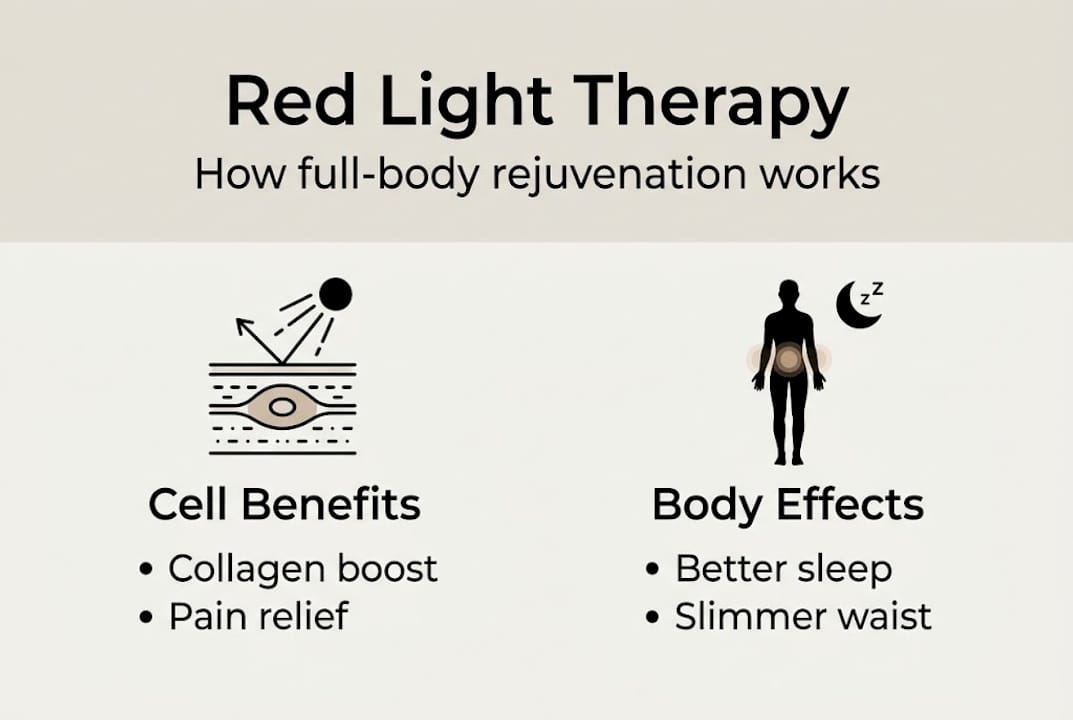
Beyond the mitochondria, red light also influences cell membrane receptors and extracellular signaling molecules — reducing fibrosis, accelerating wound repair, and triggering the release of nitric oxide, a molecule that relaxes and widens blood vessels. Better circulation means more oxygen and nutrients delivered to recovering tissue.
- Increased ATP: More cellular energy available for repair and regeneration across treated tissue.
- Reduced oxidative stress: Temporary inflammation is dampened, supporting faster recovery.
- Nitric oxide release: Improved blood flow to muscles, joints, and skin — the same mechanism targeted by many cardiovascular interventions.
- Tissue repair activation: Fibroblasts and collagen production are stimulated, supporting skin and wound healing.
- Reduced fibrosis: Healthier tissue remodeling after injury or chronic stress.
Harvard Medical School [3] notes that red light promotes mitochondrial health and gradual but measurable improvements across multiple body systems. The key word is gradual — results build over weeks of consistent use, not after a single session.
Proven Benefits: What Full-Body RLT Can Do
The evidence base for red light therapy has grown substantially. Some benefits are well-established; others are still emerging.
| Benefit Area | Evidence Level | Key Finding |
|---|---|---|
| Skin rejuvenation | Strong | 20 to 30% reduction in wrinkles in 3 months |
| Pain and inflammation | Strong | Measurable relief in arthritis and fibromyalgia |
| Wound healing | Strong | Faster tissue repair and reduced scarring |
| Sleep quality | Moderate | Improved sleep scores and lower nocturnal heart rate |
| Body composition | Moderate | Reduced waist, BMI, and inflammation markers |
| Cognitive / sports performance | Weak | Results equivocal across studies |

Pain and inflammation: Targeted and full-body sessions show measurable short-term relief for people managing arthritis, fibromyalgia, and post-exercise muscle soreness. A pain relief and inflammation wrap designed for targeted use complements full-body protocols effectively.
Sleep: A systematic review published in a Springer journal found that whole-body PBM improves sleep quality and reduces nocturnal heart rate, suggesting a calming effect on the nervous system [4].
Pain relief benefits may diminish without maintenance sessions. Consistency is the infrastructure that keeps results in place.
Realistic Results and Limitations
Not every claim you see in marketing holds up under scrutiny. A recent PMC review found strong evidence for skin, wound healing, and pain relief, while results for cognitive performance and sports recovery remain equivocal [2].
| Category | Examples | Evidence Status |
|---|---|---|
| Proven | Skin rejuvenation, wound healing, pain relief | Strong, replicated |
| Promising | Sleep, body composition, inflammation | Moderate, growing |
| Unproven | Cognitive enhancement, athletic performance | Weak or inconsistent |
What to realistically expect over time:
Weeks 1 to 2
Subtle shifts in energy, soreness recovery, or skin texture. Don't expect dramatic change yet — PBM is cumulative, not instant.
Weeks 3 to 6
Noticeable improvements in skin tone, reduced joint discomfort, and better sleep patterns in many users. First measurable changes often appear here.
Months 2 to 3
Measurable results in collagen density, pain scores, and body composition markers. This is where the clinical trial data is anchored.
Ongoing Use
Maintenance of gains. Results plateau or reverse without consistent sessions — treat it like a fitness habit, not a course of treatment.
Devices like the Airvida Radiance therapy bed are designed for full-body coverage, which matters for systemic benefits. A red light therapy panel offers targeted flexibility for specific areas.
How to Use Red Light Therapy Safely at Home
Device quality matters more than most people realize. For meaningful whole-body results, look for devices that deliver wavelengths in the 630 to 670nm (red) and 810 to 850nm (near-infrared) ranges, cover sufficient body surface area, and provide adequate irradiance in mW/cm². Underpowered devices are the most common reason people report no results.
- Cleanse skin before sessions — remove sunscreen, oils, or lotions that can block light penetration
- Wear protective goggles or keep eyes closed, especially with high-power panels
- Start with 10 to 15 minute sessions and gradually increase to 20 minutes as tolerated
- Maintain a consistent distance from the device — typically 6 to 12 inches for panels
- Avoid sessions directly after intense exercise if your skin is already inflamed
- Apply any post-session moisturizer or recovery serum after treatment — skin is more receptive immediately after
A sample at-home red light session:
- Cleanse and dry the target skin area
- Position the device at the recommended distance
- Set a timer for 10 to 20 minutes depending on experience level
- Relax, breathe, and keep the treatment area still
- Apply post-session serum or moisturizer after treatment
Plan for at least three to five sessions per week to see cumulative gains. For targeted facial protocols, the Fringe red light face mask delivers precise wavelength coverage hands-free.
If you manage a chronic illness, are pregnant, or take photosensitizing medications, consult your physician before starting any red light protocol.
Why Most Users Don't Get the Results They Want
The most common frustration with red light therapy isn't the technology — it's the expectation gap. People invest in a device, use it for two weeks, see nothing dramatic, and give up. That pattern is almost entirely driven by marketing language that promises transformation when the science actually promises gradual improvement.
Consistency and realistic tracking are everything. A recent PMC review confirms that results are cumulative and require sustained use, yet marketing hype consistently overshadows that reality. The users who report the strongest outcomes treat red light therapy like a fitness habit — not a quick fix.
Red light therapy is more marathon than miracle. Meaningful changes happen month by month.
The Fringe extra-long therapy wrap covers more surface area per session, making consistency easier to maintain without extending session time. For those who want to layer modalities, the Finnmark Trinity XL sauna combines infrared heat, steam, and red light in one system. Browse the full red light therapy collection to find the right device for your goals.
FAQ: Full-Body Red Light Therapy
How quickly will I see results from red light therapy on my body?
Most users notice early changes in skin texture or reduced soreness within a few weeks. Meaningful results — measurable changes in collagen density, pain scores, or body composition — typically develop after two to three months of regular, consistent sessions at three to five times per week.
Is whole-body red light therapy safe for daily use?
Red light therapy is considered safe and noninvasive, with no downtime or burns when used as directed. Daily use is appropriate for most healthy adults. Those who are pregnant, manage chronic illness, or take photosensitizing medications should consult a physician before starting.
Can red light therapy help with weight loss or body composition?
Research shows red light therapy may support small but statistically significant reductions in waist circumference, weight, and BMI in overweight individuals — with controlled trials reporting an average 7.28cm waist reduction. Results are most meaningful when paired with consistent lifestyle habits including movement and nutrition.
How does red light therapy differ from infrared sauna or laser therapies?
Red light therapy uses visible and near-infrared wavelengths for a gentle, non-thermal effect on cells — stimulating cellular repair without heating tissue. Medical lasers ablate or cut tissue at high intensity. Infrared saunas rely primarily on heat to drive cardiovascular and recovery effects. Each modality works through distinct pathways.
What device specs should I look for?
Look for devices that specify exact wavelengths — 630 to 670nm red and 810 to 850nm near-infrared — and publish irradiance in mW/cm². Sufficient body surface coverage matters for systemic benefits. Underpowered devices with vague specs are the most common reason people report no results.
How does full-body RLT compare to targeted devices?
Full-body devices like therapy beds and large panels drive systemic benefits — body composition, inflammation, sleep. Targeted devices like wraps, face masks, and joint applicators are better for localized pain, skin concerns, or specific recovery areas. A layered approach using both produces the broadest outcomes.
Find Your Red Light Therapy Device
From targeted wraps and face masks to full-body beds and panels — browse the collection and find the right device for your goals.
Sources
- BMC Complementary Medicine and Therapies, 2025. Full-body red light therapy and body composition: waist circumference, BMI, and inflammation. bmccomplementmedtherapies.biomedcentral.com
- PMC, 2025. Evidence review: RLT for skin, wound healing, pain, cognition, and sports performance. pmc.ncbi.nlm.nih.gov
- Harvard Health, 2025. Red light therapy for skin care: collagen, elastin, and mitochondrial health. health.harvard.edu
- Lasers in Medical Science, 2025. Whole-body photobiomodulation and sleep quality: systematic review. link.springer.com
- PMC, 2025. Photobiomodulation mechanism: ATP production, oxidative stress, and tissue repair pathways. pmc.ncbi.nlm.nih.gov
This article is for informational purposes only and does not constitute medical advice. Always consult a qualified healthcare provider before beginning any new health practice, particularly if you have a pre-existing condition, are pregnant, or are currently taking medication.