

Red Light Therapy: Benefits, Science & Home Use
At a Glance
- One controlled trial reported a 25% strength gain and 30% less soreness after training
- Some pain studies show meaningful Visual Analog Scale reductions, but effect size varies by condition and protocol
- Red and near-infrared light are used for different goals; consumer devices commonly use about 630–660 nm red and 810–850 nm NIR
- Evidence is strongest for skin, hair, wound healing, and selected pain and recovery uses — longevity claims go well beyond the data
- Home devices can work when they disclose exact wavelengths, irradiance, and a clear protocol
- Skin results usually take several weeks of consistent use — exact timing depends on the device, dose, and condition
Red light therapy gets marketed as a fix for nearly everything. That overreach has made a lot of people skeptical — and reasonably so.
The reality is more focused. There are specific, well-supported applications for skin health, wound healing, and some recovery and pain uses. The cellular mechanism is well understood. What this guide does is separate what the evidence actually supports from what has been overstated — and show you how to apply it at home without wasting money on the wrong device.
What Is Actually Happening Inside Your Cells
Red light therapy uses specific wavelengths of visible red and near-infrared light to stimulate biological processes inside your cells. It is not a heat lamp, a tanning device, or UV exposure. The light penetrates skin without causing damage, triggering repair and regeneration responses your body already knows how to run.
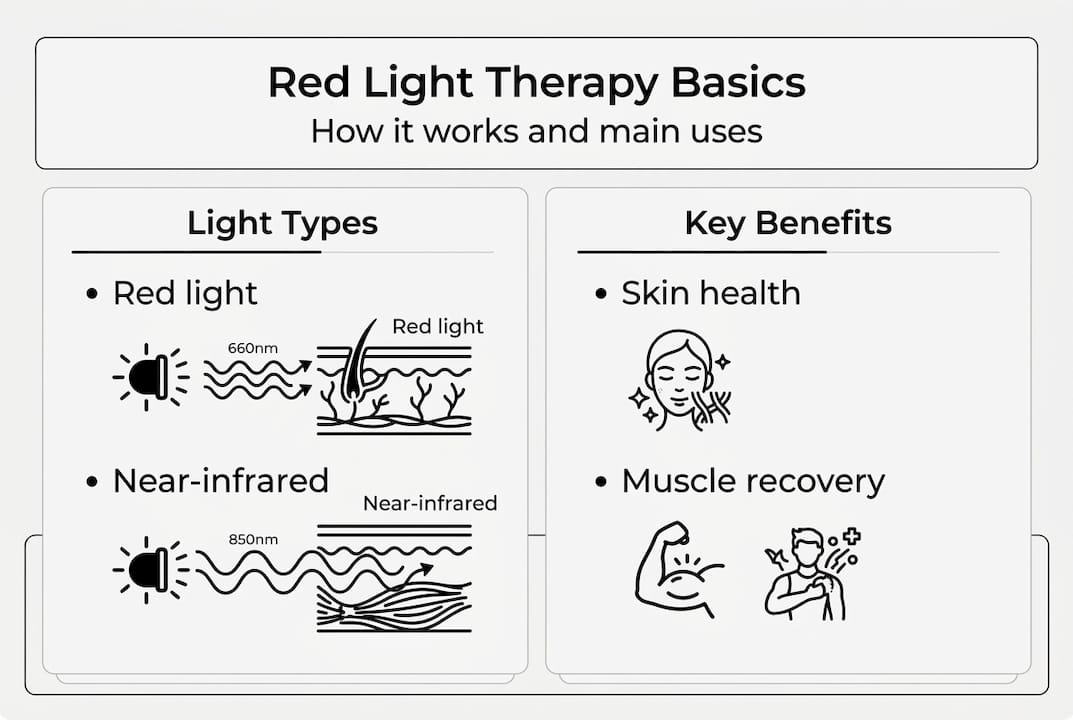
- Red light (620 to 750 nm): Works primarily at the skin surface. Effective for collagen production, acne, wound healing, and scarring. This is the wavelength driving most visible skin improvements.
- Near-infrared light (800 to 1000 nm): Penetrates deeper — reaching muscle tissue, joints, and bone. Drives recovery, pain relief, and anti-inflammatory effects that red light cannot reach.
- Mitochondrial activation: Light absorbed by cytochrome c oxidase in the mitochondria boosts ATP production, reduces inflammation, promotes collagen synthesis, and supports vasodilation and tissue repair.
Think of it as giving your cells a targeted recharge. When mitochondria are functioning optimally, the downstream effects touch nearly every aspect of recovery and regeneration. Stanford research [2] confirms that clinical applications are expanding rapidly, with dermatologists and sports medicine specialists now using RLT as a standard adjunct therapy.
| Wavelength | Range | Primary Target | Common Uses |
|---|---|---|---|
| Red light | ~630 to 660 nm (consumer) | Skin surface | Collagen, acne, wound healing |
| Near-infrared | ~810 to 850 nm (consumer) | Deep tissue | Muscle, joints, nerve tissue |
Device design matters as much as wavelength. A red light therapy panel with both red and NIR LEDs gives you the broadest therapeutic range, while smaller targeted devices from the red light therapy collection are better suited for localized treatment.
What the Research Actually Proves
The evidence for RLT is strongest for skin, hair, and wound healing, with more mixed results for recovery and pain. Effect sizes vary considerably depending on the device, dose, and condition. Here is what the data actually supports — and where it does not.
Here is a clear breakdown of what research supports versus what remains debated:
| Claim | Evidence Level | Notes |
|---|---|---|
| Skin rejuvenation | Strong | Multiple RCTs confirm wrinkle and acne improvement |
| Wound healing | Strong | Accelerated healing in clinical and surgical settings |
| Muscle recovery | Strong | 25% strength gain, 30% soreness reduction |
| Pain relief | Strong | 32% VAS reduction in OA and back pain |
| Hair regrowth | Moderate | Positive trials for androgenic alopecia |
| Brain / cognitive function | Emerging | Early trials promising; more research needed |
| Longevity extension | Weak | Hype far exceeds current evidence |
Who benefits most from RLT:
- Athletes and active individuals seeking faster recovery between training sessions
- People with chronic pain from arthritis, joint issues, or back problems
- Those managing skin concerns like acne, scarring, or early signs of aging
- Individuals with hair thinning related to androgenic alopecia
- Anyone recovering from minor wounds or post-procedure skin trauma
Pairing RLT with other recovery tools amplifies outcomes. For scalp and hair applications, a targeted RLT head wrap delivers precise coverage where it counts.
Home Devices vs. Clinical Treatment
Both work — but they serve different purposes and produce different intensities of effect. Clinical devices operate at higher power outputs, use precisely calibrated protocols, and are administered by trained practitioners. Home devices are lower intensity but safe, convenient, and effective for maintenance, recovery, and skin health when used correctly.
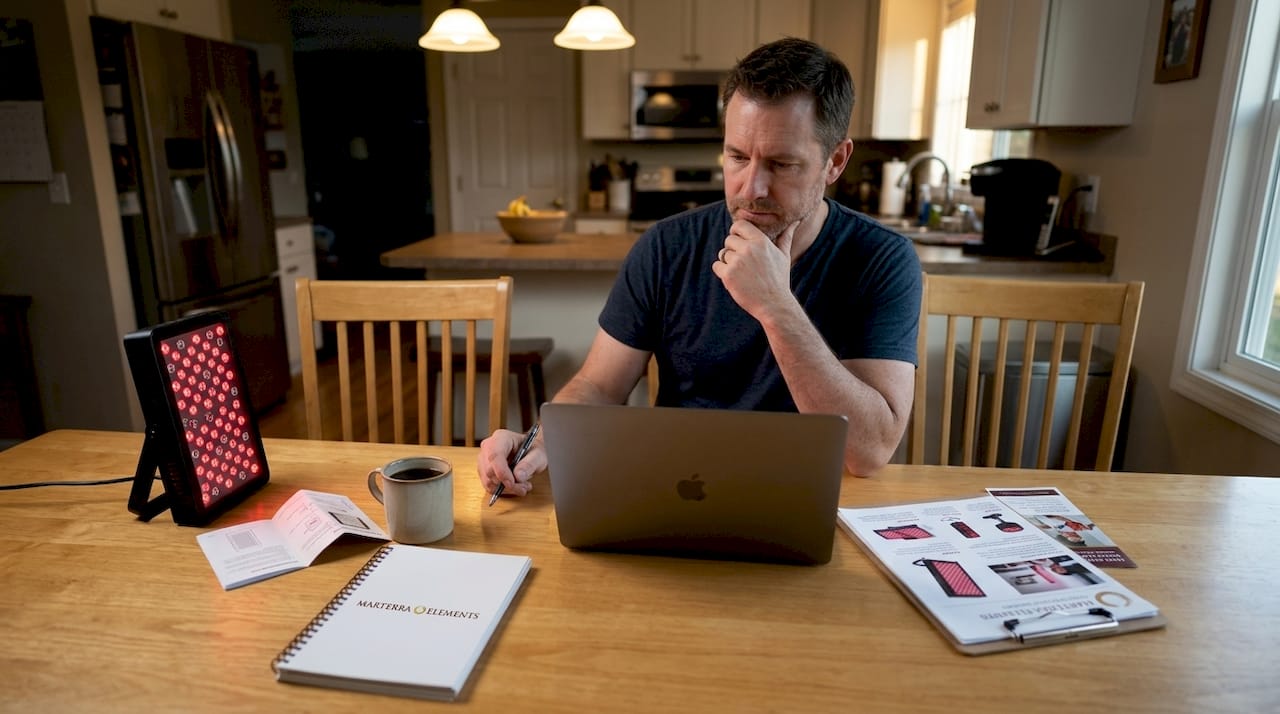
The key is not choosing between home and clinic. It is understanding what each is designed to do. Home devices support consistency and daily integration. Clinical sessions provide intensity for acute or complex conditions.
Home Devices
Lower power output. Safe for daily use. Effective for skin health, ongoing recovery, and pain management. Best when used consistently 3 to 5 times per week.
Clinical Treatment
Higher irradiance and precisely calibrated protocols. Administered by trained practitioners. Better suited for acute or complex conditions where intensity matters more than convenience.
Full-Body Panels
Broadest therapeutic range. Ideal for whole-body recovery, systemic inflammation, and skin health across large surface areas. Both red and NIR LEDs in a single session.
Targeted Wraps & Masks
Flexible, hands-free treatment for specific joints, limbs, or facial skin. Best for localized pain, joint recovery, or precision skin applications. Easier to integrate into daily routine.
Before buying any home device, ask these four questions:
- Does it specify exact wavelengths in nm for both red and NIR?
- What is the irradiance — power output in mW/cm²?
- Does the manufacturer provide a recommended treatment protocol?
- Are there any contraindications for my health conditions or medications?
For full-body coverage at home, a RLT therapy bed offers clinical-adjacent exposure without leaving your house. For targeted areas like limbs or joints, a long RLT wrap provides flexible, hands-free treatment.
Your Optimal Protocol
Getting results from RLT is not complicated. It requires consistency, correct dosing, and a few non-negotiable safety habits.
Frequency
Aim for 3 to 5 sessions per week. Sporadic use will not produce meaningful results. Daily short sessions are better than occasional long ones.
Duration
10 to 20 minutes per area. RLT follows a biphasic dose response — too much light reverses the benefits. Stick to manufacturer guidelines.
Eye Protection
Always wear the provided goggles or approved eye protection. Non-negotiable — this applies even to low-intensity home devices used at any wavelength.
Timeline
Visible changes for skin concerns typically appear within 4 to 8 weeks. Muscle recovery and pain benefits are often felt sooner, within the first 2 to 3 weeks.
- Match device to goal. A red light face mask for skin. A multi-joint wrap for knees, elbows, and ankles. A full panel for whole-body recovery.
- Check for medication interactions. Certain medications increase photosensitivity. Review your current prescriptions with a healthcare provider before starting.
- Track your progress. Take photos for skin, note pain levels or recovery metrics. What gets measured gets improved.
- Monitor your skin. If you notice unusual redness, irritation, or sensitivity, reduce session frequency and consult a professional.
The Bottom Line
Most wellness content on RLT either dismisses the technology entirely or elevates it to near-miraculous status. Neither serves you well.
The hype around longevity and brain benefits significantly exceeds what current evidence supports. Early trials are interesting — but interesting is not the same as proven. Where RLT genuinely earns its place is in targeted, consistent application for pain, skin, and recovery. These are the applications with replicable data and real-world results you will actually feel.
The most effective approach treats RLT as one layer of a holistic wellness plan, not a replacement for sleep, movement, or nutrition. Demand wavelength specifics and ignore claims that sound too broad to be true. Harvard Health [3] and Scientific American [4] both reinforce the same message: real benefits exist, but realistic expectations matter.
RLT is a meaningful tool. Used with intention and realistic expectations, it delivers.
FAQ: Red Light Therapy
Is red light therapy safe to use at home?
When using quality devices as directed and wearing proper eye protection, red light therapy is considered safe for most people. Risks are minimal — temporary redness is the most commonly reported response. Those with photosensitivity conditions or taking light-activated medications should consult a healthcare provider first.
How soon will I see results from red light therapy?
Most people notice improvements within 4 to 8 weeks of consistent use for skin concerns. Muscle recovery and pain benefits often appear sooner — within the first 2 to 3 weeks of regular sessions. Clinical data confirms measurable gains in strength and soreness reduction with consistent use.
What is the difference between red and near-infrared light?
Red light (620 to 750 nm) targets surface skin layers — effective for collagen production, acne, and wound healing. Near-infrared (800 to 1000 nm) penetrates deeper to reach muscle, joint, and nerve tissue. For the broadest therapeutic range, choose a device that delivers both wavelengths.
How does red light therapy help with muscle recovery?
NIR light penetrates deep enough to reach muscle tissue, where it boosts ATP production, reduces inflammation, and accelerates cellular repair. Controlled trials show a 25% strength gain and 30% reduction in post-exercise soreness with consistent use. Best paired with post-workout sessions rather than used as a substitute for active recovery.
Do home devices work as well as clinical RLT treatments?
Home devices are less potent than clinical-grade equipment but deliver real, measurable results for most wellness goals when used correctly. Clinical sessions are better suited for acute or complex conditions requiring higher intensity. The advantage of home devices is consistency — daily access without appointments or travel.
What should I look for when buying a red light therapy device?
Exact wavelength specifications in nm (not just "red light"), published irradiance in mW/cm², a clear treatment protocol from the manufacturer, and information about contraindications. Any device that cannot answer these questions clearly is not worth buying.
Can red light therapy help with pain?
Yes. Studies report a 32% reduction on the Visual Analog Scale for conditions including osteoarthritis and chronic back pain. The NIR wavelength drives most of the pain relief benefit by reducing inflammation and supporting tissue repair at depth. Consistent use — 3 to 5 sessions per week — is required for sustained results.
Are there side effects or people who should avoid red light therapy?
Side effects are rare and typically limited to mild, temporary redness. People with photosensitivity conditions or those taking light-activated medications should consult a healthcare provider before starting. RLT is not a standalone treatment for cancer or serious medical conditions and should not be substituted for professional medical care.
The Finnmark FD-5 Trinity XL combines infrared sauna, steam, and red light therapy in one premium unit — a complete recovery environment at home. For flexible, targeted use, the red light therapy wrap delivers direct treatment to specific areas with ease.
Find the Right Red Light Therapy Device
Browse the full RLT collection — panels, wraps, face masks, and full-body beds, all selected for wavelength precision and real-world results.
Sources
- Sport Sciences for Health, 2026. RLT clinical outcomes: muscle recovery, pain reduction, and skin rejuvenation. link.springer.com
- Stanford Medicine, 2025. Clinical applications of red light therapy in dermatology and sports medicine. med.stanford.edu
- Harvard Health, 2025. Red light therapy for skin care: what the evidence shows. health.harvard.edu
- Scientific American, 2025. Does red light therapy work? What the research says. scientificamerican.com
This article is for informational purposes only and does not constitute medical advice. Always consult a qualified healthcare provider before beginning any new health practice, particularly if you have a pre-existing condition, are pregnant, or are currently taking medication.