

Red Light vs Infrared Therapy: Which Is Best for Home Wellness?
At a Glance
- Red light (620–700nm) targets surface tissue — skin, collagen, and wound support — penetrating 1 to 2cm
- Near-infrared (700–1100nm) is invisible to the eye and penetrates 3 to 5cm, reaching muscles, joints, and tendons
- Both work through photobiomodulation — light absorbed by cytochrome c oxidase in mitochondria boosts ATP and modulates inflammation
- Research suggests combining red and NIR wavelengths addresses both surface and deep tissue in a single session
- Far-infrared saunas are a distinct modality — they work through heat, not photon absorption. The two are complementary, not interchangeable
- Device specs matter — always verify exact wavelengths in nm and irradiance in mW/cm² before buying
Red light therapy and near-infrared therapy are often lumped together as if they are the same treatment. They are not. While both use light to trigger responses at the cellular level, they work at different wavelengths, reach different tissue depths, and serve very different wellness goals.
If you have been using a red light panel hoping to soothe sore joints, or an infrared sauna expecting skin rejuvenation, you may be getting partial results at best. This guide breaks down the science behind each therapy, explains what each one does inside your body, and helps you build a smarter, more targeted home recovery routine.
Red Light and Infrared Therapy Explained
Both therapies fall under the broader category of photobiomodulation (PBM) — a process where specific wavelengths of light are absorbed by cells to trigger biological responses. The key difference is wavelength, and wavelength determines everything: how deep the light travels, which tissues it reaches, and what it can actually do.
Red light therapy uses visible red light in the 620 to 700nm range, penetrating roughly 1 to 2 centimeters into the skin. At this depth, it targets surface-level tissues, making it effective for skin health, collagen production, and wound support. You can see red light with the naked eye — which is why red light panels have that warm, glowing appearance.
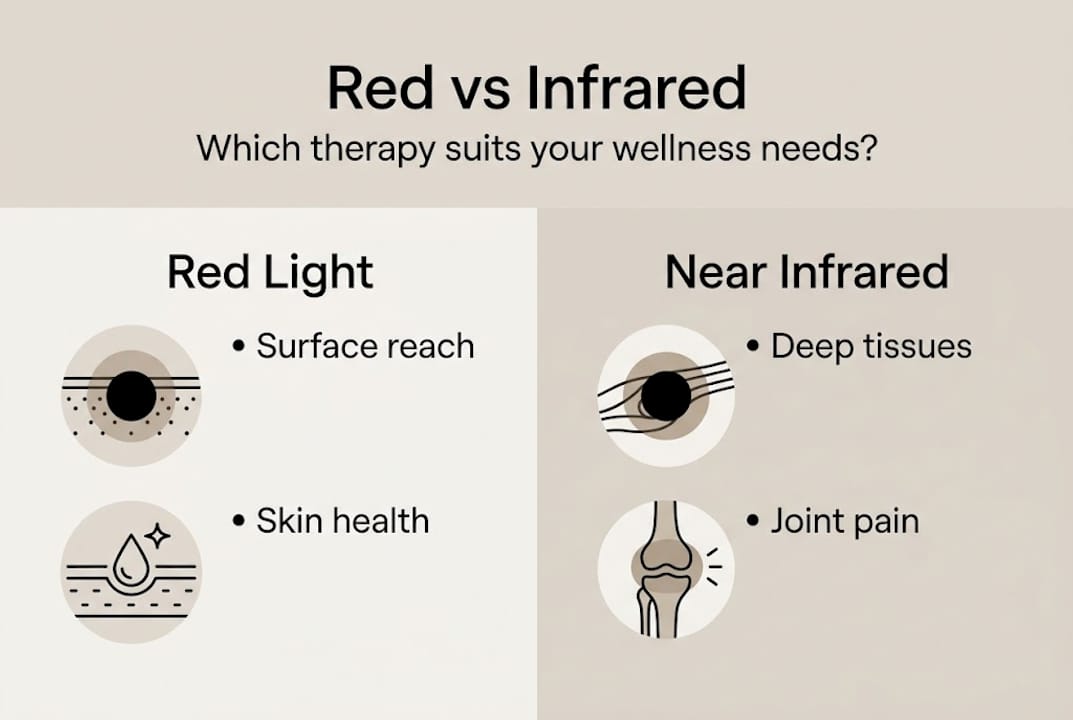
Near-infrared (NIR) therapy operates in the 700 to 1100nm range, which is invisible to the human eye. Because of its longer wavelength, NIR penetrates 3 to 5 centimeters or more, reaching muscles, joints, tendons, and even bone. This deeper reach makes NIR the preferred choice for musculoskeletal recovery and systemic inflammation.
| Feature | Red Light (620–700nm) | Near-Infrared (700–1100nm) |
|---|---|---|
| Visible to the eye | Yes | No |
| Penetration depth | 1 to 2cm | 3 to 5cm+ |
| Primary targets | Skin, surface tissue | Muscles, joints, tendons |
| Common uses | Collagen, wound support | Muscle recovery, joint support |
| Device types | Face masks, panels | Panels, wraps, combo units |
Many modern units combine both red and NIR wavelengths, giving you access to the full spectrum of red light science in a single session. Understanding which wavelengths your device emits is the first step toward getting real results.
- Red light is visible; NIR is not
- Wavelength determines tissue depth and effect
- Both use photobiomodulation as their core mechanism
- Device specs matter — always check the nm range before buying
How Red and Infrared Impact Your Body
The shared mechanism behind both therapies is photobiomodulation. Light photons are absorbed by an enzyme called cytochrome c oxidase (CCO), which sits inside your mitochondria. This absorption boosts ATP production, reduces oxidative stress, and modulates inflammation at the cellular level. Think of it as giving your cells a direct energy recharge.
But the depth of that recharge is where red and NIR diverge in meaningful ways.
Red light's impact is concentrated in the skin and surface layers. It stimulates fibroblasts — the cells responsible for producing collagen and elastin — making it a strong tool for reducing fine lines, improving skin tone, supporting surface wound recovery, and promoting hair follicle health. If your primary goal is skin rejuvenation or surface-level tissue support, red light is your workhorse.
NIR's impact goes deeper. Because it reaches muscle bellies, joint capsules, and connective tissue, NIR is better suited for post-workout recovery, chronic joint discomfort, and deeper inflammatory conditions. Athletes and active individuals often notice faster bounce-back from training sessions when NIR is part of their routine.
Research suggests that combining both wavelengths produces broader outcomes. Clinical data shows that photobiomodulation using red light at 660nm combined with NIR at 808nm reduces post-surgical pain, swelling, and inflammation more effectively than antibiotics alone in randomized controlled trials [1] — a significant finding for anyone managing recovery at home.
Individual response varies. Skin tone, tissue density, and overall health all influence how well light penetrates and how strongly cells respond. Dose also matters — more light exposure does not always mean better results, a concept addressed in the safety section below.
Choosing Red, Infrared, or Both for Your Routine
The right approach starts with identifying your primary wellness need.
Skin Health & Surface Recovery
Red light (620–700nm) is your go-to. Use a face mask or panel close to the skin for collagen support, tone improvement, and surface wound support. A therapy wrap can also target specific areas with precision.
Joint Pain & Deep Muscle Recovery
NIR is the better choice. Its deeper penetration reaches the tissue layers where inflammation and soreness actually originate. A targeted joint and muscle wrap delivers concentrated NIR to knees, elbows, or ankles.
Full-Body Recovery & Systemic Wellness
Combining red and NIR gives you the broadest coverage. Home panels that emit both wavelengths simultaneously treat skin and deep tissue in a single session — the most efficient approach for general wellness.
Post-Workout Recovery
NIR-dominant sessions within 30 to 60 minutes after training may help reduce delayed onset muscle soreness (DOMS) and support faster tissue repair. Home panels designed for recovery routines are well-suited for this use case.
One critical distinction: do not confuse NIR therapy with far-infrared (FIR) saunas. FIR saunas use heat to promote relaxation, circulation, and cardiovascular adaptation — a thermal effect. NIR photobiomodulation works through light absorption at the cellular level, not heat. They are complementary tools that operate through entirely different mechanisms, not interchangeable ones.
Irradiance (power output in mW/cm²) determines how much light energy reaches your tissue at a given distance. A low-power device held too far away may deliver almost no therapeutic dose. Always follow manufacturer guidelines for distance and session duration.
Nuances, Safety, and What Most People Get Wrong
Skin type affects your results. Melanin absorbs light, which means penetration varies by skin tone. Individuals with deeper skin tones may need slightly longer sessions or higher irradiance to achieve the same tissue dose. This is not a limitation — just a variable worth knowing.
More is not always better. Photobiomodulation follows a biphasic dose response — there is an optimal window of exposure. Too little light produces minimal effect. Too much can actually inhibit the cellular response you are trying to trigger. Finding your optimal session length and device distance is more important than maxing out exposure time.
FIR saunas are not red or NIR therapy. This is the most common source of confusion in the wellness space. Far-infrared saunas generate heat that warms the body from the inside out — supporting cardiovascular adaptation, relaxation, and circulation. Red and NIR therapy work through photon absorption in mitochondria, not thermal effects. Both are valuable, but they work through distinct physiological pathways and should not be confused.
- Assuming any "infrared" device delivers photobiomodulation
- Using a red light device for deep joint pain without NIR wavelengths
- Skipping device specs and trusting marketing language alone
- Expecting rapid results without consistent, properly dosed sessions
The evidence landscape also has nuance. Stanford research [2] confirms strong clinical support for red light in skin and hair applications, while recovery, cardiovascular, and neurological uses show promising preclinical data but still need larger randomized trials. That does not mean those applications are ineffective — it means setting realistic expectations. Use a face mask for skin with confidence, while treating deeper recovery uses as a powerful complement to your broader routine.
The smartest approach is not chasing the most powerful device. It is matching the right wavelength to the right tissue at the right dose, consistently.
Why the Right Therapy Mix Beats Following Trends
Most wellness guides treat red light, NIR, and infrared saunas as interchangeable upgrades. Buy the biggest panel, sit in the sauna longer, stack every modality. That approach misses the point entirely.
The real advantage comes from understanding your body's specific needs and matching the tool to the job. Someone managing chronic knee inflammation needs NIR at the right dose — not a red light face mask. Someone focused on skin rejuvenation does not need a full-body NIR panel. Context drives results.
It is also easy to get caught up in influencer-driven wellness trends that prioritize aesthetics over function. A beautifully designed panel means nothing if its wavelengths do not match your recovery goals. Consistency with the right device outperforms sporadic use of the wrong one every time.
For deeper guidance on building a science-informed home routine, evidence grounded in clinical research is a far better compass than trending content. Your body will tell you what is working — pay attention to that signal more than the hype.
The Finnmark FD-5 Trinity XL delivers infrared heat, steam, and red light in one premium unit — ideal for households that want all three modalities. For targeted sessions, the Fringe red light therapy panel combines red and NIR wavelengths in a home-ready format. Explore the full range of saunas and wellness tools to find the setup that fits your space and goals.
FAQ: Red Light vs Near-Infrared Therapy
Is infrared the same as red light therapy?
No. Red light therapy uses visible wavelengths between 620 and 700nm for surface-level effects, while near-infrared operates at 700 to 1100nm for deeper tissue applications. Far-infrared saunas are a separate modality entirely — they work through heat, not photon absorption. Related but distinct tools.
What therapy is best for joint pain?
Near-infrared therapy is the stronger choice for joint pain. Its 3 to 5cm penetration depth reaches the deeper tissue layers — muscle bellies, joint capsules, connective tissue — where joint inflammation and soreness actually originate. Red light alone does not reach these depths.
Can I use red and near-infrared light together?
Yes — and research suggests it is often the most effective approach. Combining both wavelengths in a single session addresses surface tissue and deeper structures simultaneously, giving you broader recovery and wellness benefits than either wavelength alone.
Are infrared saunas the same as NIR therapy?
No. Infrared saunas — particularly far-infrared — use heat to promote circulation, cardiovascular adaptation, and relaxation. NIR therapy works through cellular photon absorption via photobiomodulation, not thermal effects. Both are valuable modalities, but they operate through different mechanisms and are not substitutes for each other.
How do I know if my device delivers real NIR wavelengths?
Look for devices that specify exact wavelengths in nanometers — for example, 810nm or 850nm — rather than vague claims like "infrared." Published irradiance in mW/cm² is also a sign of a transparent, clinically grounded product. If a brand cannot provide these specs, treat that as a red flag.
Does skin tone affect red or NIR therapy results?
Yes. Melanin absorbs light, so penetration varies by skin tone. Those with deeper skin tones may benefit from slightly longer sessions or higher irradiance to achieve the same tissue dose. This is a variable to account for — not a barrier to effective results.
Find the Right Red and Infrared Device
From targeted wraps and panels to full-spectrum sauna systems — browse the collection and match the right wavelength to your goals.
Sources
- Lasers in Medical Science, 2025. Combined red (660nm) and NIR (808nm) photobiomodulation vs. antibiotics for post-surgical pain and edema. link.springer.com
- Stanford Medicine, 2025. Clinical applications of red light therapy in dermatology and hair restoration. med.stanford.edu
- Red Light Therapy Expert. Red vs NIR wavelength comparison: penetration depth and tissue targets. redlighttherapy.expert
This article is for informational purposes only and does not constitute medical advice. Always consult a qualified healthcare provider before beginning any new health practice, particularly if you have a pre-existing condition, are pregnant, or are currently taking medication.